Mailchimp vs ActiveCampaign vs Klaviyo: Which Email Platform Is Right for Your SMB in 2026?




Picking the Wrong Platform Costs More Than You Think
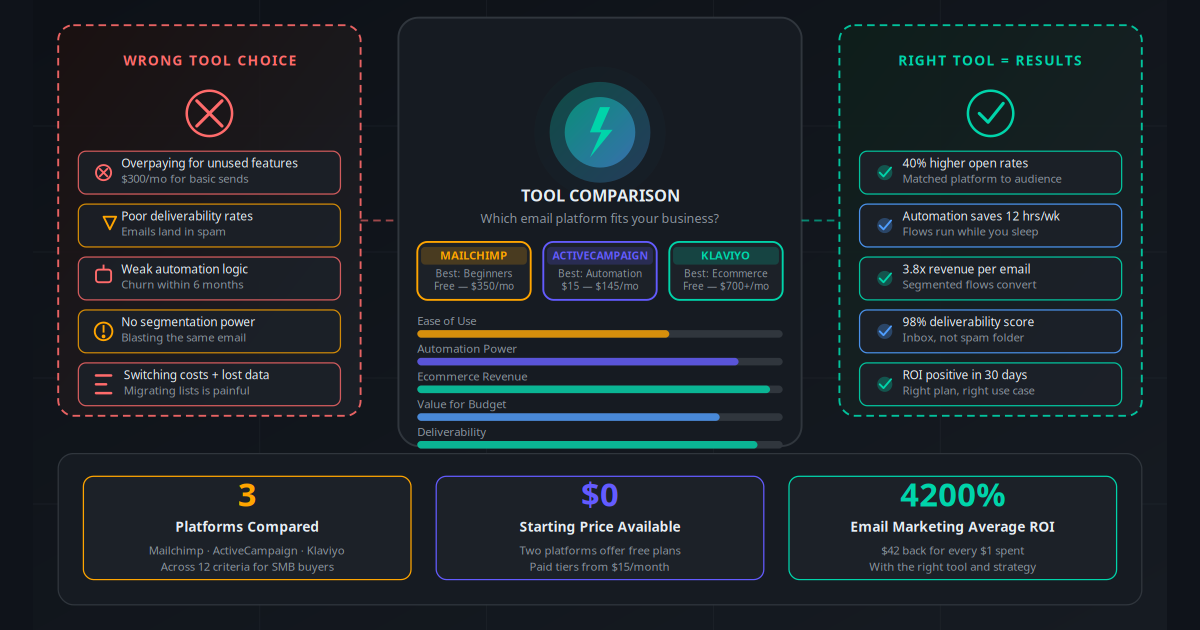
Email still delivers the highest ROI of any digital marketing channel — $42 returned for every $1 spent, according to the Data & Marketing Association. But that number assumes you have the right tool for your use case. The wrong platform wastes more than money. It wastes the one resource you cannot buy back: your subscribers' attention.
Here is what happens in practice. A retail store picks Mailchimp because it is free. Twelve months later they hit the contact limit, discover they cannot do abandoned cart flows without upgrading to a plan that costs more than Klaviyo, and have to migrate their entire list. A service business signs up for Klaviyo because they read it is the best, then spends three months frustrated because the platform is built around purchase events and their contacts are leads, not buyers. A growing agency builds every client on ActiveCampaign, then realises the per-user pricing is eating their margins.
Each of these platforms is genuinely excellent — for the right use case. The comparison guides you find online often skip this nuance. This one does not. By the end of this article you will know exactly which platform belongs in your business, why, and what you should set up in it first.
For context on how email automation fits into a broader automation strategy, see the guide to email automations every business should run — it covers the sequences that generate revenue regardless of which tool you use.
Key Takeaway
Mailchimp wins on simplicity, ActiveCampaign wins on automation power for service and B2B businesses, and Klaviyo wins on ecommerce revenue. Choosing by price alone will cost you more in the long run than choosing by fit.
What Each Platform Is Built For
Before comparing features side by side, it helps to understand the design philosophy behind each tool. These platforms were not built to compete with each other — they were built for different problems, and their feature sets reflect that.
Mailchimp: The Email Marketing Gateway
Mailchimp was designed to make professional email accessible to everyone. It launched as a tool for small businesses that had no marketing team, no HTML skills, and no budget. That philosophy is still visible in 2026. The drag-and-drop builder is genuinely excellent. The template library is vast. The free plan is real — 500 contacts and 1,000 sends per month at no cost. For a business sending its first email newsletter, there is nothing faster to get started with.
The limitation appears when you need sophistication. Mailchimp's automation logic — it calls them Customer Journeys — is linear by default. Complex branching flows that respond to user behaviour require the Premium plan. Segmentation based on predicted behaviour or lifetime value is surface-level compared to its competitors. A/B testing is available but multivariate testing is gated behind higher tiers. Mailchimp is an excellent starting point. It is rarely the destination for a business serious about using email as a revenue channel.
ActiveCampaign: The CRM-Powered Automation Engine
ActiveCampaign was built for businesses that want email to be part of a broader relationship management strategy. It combines email marketing with a built-in CRM, lead scoring, site tracking, and one of the most powerful visual automation builders in the market. Its flows can branch on dozens of conditions: has the contact opened a specific email, visited a specific page, scored above a threshold, moved to a specific deal stage, or been tagged in a specific way. You can build logic that would require custom development in most other platforms.
The trade-off is complexity. ActiveCampaign takes longer to learn. Setting up a sophisticated multi-sequence automation is genuinely powerful once built, but the process requires structured thinking and time. For businesses willing to invest that time — typically service businesses, B2B companies, agencies, and coaches — the payoff is automation that replaces significant human follow-up effort. Check out how AI-powered lead generation workflows can feed directly into ActiveCampaign to create a fully automated sales funnel.
Klaviyo: The Ecommerce Revenue Engine
Klaviyo was built for one thing: generating more revenue from an ecommerce email list. It connects directly to Shopify, WooCommerce, BigCommerce, and other platforms and pulls in real-time purchase data, browsing behaviour, cart events, and product catalogue data. This allows it to do things the other two platforms simply cannot: segment by purchase frequency, trigger flows from specific product views, personalise emails with AI-recommended products, and attribute exact revenue to individual email campaigns.
Klaviyo's SMS channel is also deeply integrated with its email flows, allowing retailers to run coordinated email-plus-SMS sequences. For an ecommerce store generating more than $10,000 per month in revenue, Klaviyo typically delivers the highest measurable return. For service businesses, B2B companies, or businesses with no online store, it is overpriced and under-suited to the use case.
Pricing Compared: Free Plans, Paid Tiers, and Hidden Costs
Pricing in email marketing is notoriously difficult to compare because all three platforms price by contact count, not by features alone. Here is the 2026 pricing landscape across common list sizes:
| Contacts | Mailchimp (Standard) | ActiveCampaign (Plus) | Klaviyo (Email) |
|---|---|---|---|
| 500 (Free tier) | Free (1,000 sends/mo) | $15/mo (trial) | Free (500 sends/mo) |
| 1,000 | ~$20/mo | $29/mo | $20/mo |
| 2,500 | ~$45/mo | $49/mo | $45/mo |
| 5,000 | ~$75/mo | $99/mo | $100/mo |
| 10,000 | ~$135/mo | $174/mo | $175/mo |
| 25,000 | ~$270/mo | $286/mo | $400/mo |
A few things this table does not show: Mailchimp charges for all contacts in your account, including unsubscribed contacts on some plans. This catches many users off guard when their bill increases despite lower active sending. ActiveCampaign's Plus plan includes a full CRM, landing page builder, and conditional content — features that cost extra in Mailchimp. Klaviyo's pricing reflects its ecommerce revenue attribution, but if you are not an ecommerce business you are paying for features you will never use.
The cheapest plan is not the most cost-effective one. The right tool — even at a higher monthly price — will generate more revenue per contact than the wrong tool at any price.
For businesses building comprehensive automation stacks, it is worth comparing how these tools fit alongside platforms covered in the Make.com vs Zapier vs n8n comparison, since your email tool will often be the trigger or destination for cross-platform workflows.
Automation Depth: Where the Real Differences Lie
This is where the platforms diverge most significantly. Automation depth determines whether your email tool works for you while you sleep — or requires constant manual intervention.
Mailchimp Customer Journeys
Mailchimp's automation tool, Customer Journeys, allows you to build visual flows triggered by events: subscriber joins list, contact makes purchase, specific date, link clicked. For simple flows — welcome sequence, birthday email, post-purchase thank you — it works well and is fast to configure. The limitation is branching. On the Standard plan, you can create two-branch if/then splits. Complex multi-path logic based on CRM data or contact scoring requires Premium. There is no native lead scoring. The CRM integration is shallow — Mailchimp is fundamentally an email tool, not a CRM, which means it does not track deal stages, pipeline movement, or sales activities as first-class objects.
ActiveCampaign Automations
ActiveCampaign's automation builder is the most powerful of the three for non-ecommerce use cases. You can chain unlimited automation steps with unlimited branching conditions. A single automation can span months of contact with dozens of decision points, modifying contact data, adjusting scores, moving deals in the CRM, sending internal notifications to sales reps, and triggering other automations. Site tracking means the platform knows when a contact visits a specific page — you can trigger an email the moment someone returns to your pricing page after going cold for 30 days. For businesses managing long sales cycles, this depth is transformative. Many CRM automation strategies are best implemented directly inside ActiveCampaign rather than via a separate CRM.
Klaviyo Flows
Klaviyo's automation tool, Flows, is purpose-built for ecommerce lifecycle events. Out of the box you can activate: abandoned cart, browse abandonment, post-purchase, winback, welcome series, price drop, and back-in-stock flows. Each flow automatically pulls live product data from your connected store — no manual linking of products. AI-powered product recommendation blocks show each subscriber the items they are most likely to buy based on browsing and purchase history. Revenue attribution happens automatically at the email level. For ecommerce, Klaviyo flows are the most commercially effective sequences available on any email platform. For everyone else, these features do not apply.
Deliverability and Inbox Placement
The best-written email in the world generates zero revenue if it lands in spam. Deliverability depends on your list hygiene, domain reputation, and the infrastructure behind your sending platform. Here is how the three platforms compare:
| Platform | Avg. Inbox Placement | Dedicated IP (available) | Predictive Send Time | List Cleaning |
|---|---|---|---|---|
| Mailchimp | ~88–90% | Yes (Premium) | Yes | Manual + auto-archive |
| ActiveCampaign | ~91–93% | Yes (Enterprise) | Yes (Predictive Sending) | Automated bounce handling |
| Klaviyo | ~90–92% | Yes (paid) | Yes (Smart Send Time) | Suppression lists built-in |
ActiveCampaign consistently leads on raw deliverability metrics, particularly because its Predictive Sending feature trains on each individual subscriber's open history to find their best send window. All three platforms support DKIM, DMARC, and SPF authentication — make sure you have configured these for your sending domain, as they are the single biggest deliverability factor in your control. Managing AI email management at scale becomes far easier once your sending infrastructure is properly configured.
Which Business Type Should Use Which Platform
Ecommerce Store (Shopify / WooCommerce)
Problem: High cart abandonment rate, repeat purchase rate below 20%, no automated post-purchase sequences. Solution: Klaviyo, connected to your store, with abandoned cart flow, post-purchase upsell flow, and 90-day winback sequence. Result: Businesses typically see 15–30% of their email revenue come from automated flows within 60 days of proper Klaviyo setup.
Professional Services (Consultants, Coaches, Agencies)
Problem: Leads come in from multiple sources, follow-up is inconsistent, deals go cold after the initial enquiry. Solution: ActiveCampaign with lead scoring, a nurture sequence triggered by lead magnet download, and a deal pipeline that moves based on email engagement. Result: One agency using this setup reduced their average lead-to-close time from 47 days to 19 days and increased close rate by 31%.
Local Service Business (Clinic, Salon, Restaurant)
Problem: No system for re-engaging past customers, promotional emails sent manually with inconsistent timing. Solution: Mailchimp Standard for simple monthly newsletters plus a re-engagement sequence for contacts who have not visited in 90 days. Or step up to ActiveCampaign if appointment reminders and CRM tracking are needed. Result: A dental clinic added $4,800/month in incremental revenue from a single reactivation sequence to dormant patients.
SaaS / Software Business
Problem: Trial users not converting, activated users churning at 30 days, no onboarding email sequence. Solution: ActiveCampaign with behavioural triggers connected to the product database via webhook. Emails fire based on in-app actions: signed up but did not complete onboarding, completed onboarding but did not use the core feature, used core feature but has not invited a team member. Result: Properly sequenced onboarding emails have been shown to increase trial-to-paid conversion by 20–40% across SaaS businesses. Combine this with AI customer support workflows for a complete retention stack.
B2B Wholesale or Distribution
Problem: Reorder reminders are manual, seasonal promotions reach the wrong buyers, no system for cross-selling complementary product categories. Solution: ActiveCampaign or Klaviyo (if using a supported ecommerce backend) with product-category-based segmentation and reorder timing automation. Contacts who purchased Category A in month 1 get a targeted campaign for Category B in month 3. Result: Average order value increase of 22% reported by wholesale businesses using systematic cross-sell sequences.
How to Implement Email Automation in 8 Steps
Choose your platform based on use case, not price: Ecommerce goes Klaviyo. Service/B2B goes ActiveCampaign. True beginners with a simple newsletter start on Mailchimp and migrate when they hit limits. Make this decision once and commit — switching platforms costs 3 to 8 weeks of rebuilding.
Configure your sending domain authentication: Add SPF, DKIM, and DMARC records to your DNS before sending a single email. This protects your domain reputation and is now a hard requirement for Gmail and Outlook bulk sending. Every platform has a step-by-step guide for this — complete it on day one.
Import and segment your existing list: Do not dump everyone into one list. Segment by acquisition source (website opt-in, past customer, trade show), by engagement history if you have it, and by category interest if applicable. Clean the list — remove unengaged contacts older than 18 months before importing, not after. A clean 2,000-contact list outperforms a dirty 8,000-contact list every time.
Build your welcome sequence first: A welcome sequence is the highest-engagement email series you will ever send. New subscribers open at 4x the rate of regular broadcasts. Build a 3 to 5 email sequence: email 1 delivers the lead magnet or confirms the opt-in, email 2 introduces your business and what you help with, email 3 provides your most valuable free resource, emails 4 to 5 present a soft call to action. Do not skip this in favour of broadcasts.
Configure your highest-revenue automated flow: For ecommerce this is abandoned cart. For services this is the post-enquiry nurture sequence. For SaaS this is the onboarding sequence. Set up the one flow that will generate the most revenue and get it live before building anything else. Many businesses never get past this step — and that one flow still generates compounding return month after month.
Set up a regular broadcast schedule: Automated flows handle the relationship layer. Broadcasts (weekly or fortnightly) handle the content layer. Consistency matters more than frequency. One well-written weekly email beats four mediocre ones every time. Templates from your AI workflow automation stack can help generate first-draft email content at scale without sacrificing quality.
Connect to your CRM and other tools: Email marketing in isolation is powerful. Email marketing connected to your CRM, booking system, ecommerce platform, and customer support tool is transformative. Use native integrations where available. For custom connections, Make.com or Zapier bridge the gaps. Every integration you add multiplies the intelligence your email platform has about each contact.
Review metrics monthly and optimise: Track open rate (aim for 35%+), click rate (aim for 3%+), unsubscribe rate (keep below 0.3%), and revenue per email (your most important metric). Set a 30-minute monthly review cadence. Delete flows that have not generated a single conversion in 90 days. Double down on the sequences driving measurable revenue. Email automation is not set-and-forget — it is set-and-iterate.
Head-to-Head Scorecard Across 12 Criteria
This scorecard rates each platform 1 to 5 for the criteria that matter most to SMBs. It is opinionated by design — average scores hide the real differences.
| Criterion | Mailchimp | ActiveCampaign | Klaviyo |
|---|---|---|---|
| Ease of setup | 5/5 | 3/5 | 3/5 (ecomm) / 2/5 (other) |
| Automation depth | 2/5 | 5/5 | 4/5 (ecomm) / 2/5 (other) |
| Ecommerce revenue features | 2/5 | 3/5 | 5/5 |
| CRM depth | 1/5 | 5/5 | 2/5 |
| Deliverability | 4/5 | 5/5 | 4/5 |
| Template library | 5/5 | 3/5 | 4/5 |
| Lead scoring | 1/5 | 5/5 | 2/5 |
| SMS integration | 1/5 | 3/5 | 5/5 |
| Reporting / analytics | 3/5 | 4/5 | 5/5 (ecomm revenue) |
| Value for service businesses | 3/5 | 5/5 | 1/5 |
| Free plan quality | 5/5 | 2/5 | 4/5 |
| Integration ecosystem | 4/5 | 5/5 | 4/5 |
Reading this scorecard: if your column shows mostly 4s and 5s, that is your platform. If you see a mix of highs and lows, pay attention to which criteria are most important to your specific use case rather than adding up totals.
Real-World ROI: What Businesses Are Actually Seeing
"We switched from Mailchimp to ActiveCampaign in January and built our lead nurture sequence properly for the first time. By March we had closed three clients who came in through flows that were running completely on autopilot. That is $18,000 in revenue from a $99/month tool."
— Founder, digital marketing consultancy, 2-person teamAcross businesses that have set up email automation properly — welcome sequences, nurture flows, and re-engagement campaigns — the consistent returns look like this:
- Revenue from automated flows vs broadcasts: Automated flows typically generate 60–80% of total email revenue despite representing a fraction of email volume. One well-configured abandoned cart sequence can generate more revenue per month than 12 months of newsletters.
- Open rates on automation emails: Welcome sequence email 1 typically sees 50–65% open rates. Regular broadcast average is 20–25%. The automation advantage is massive and permanent.
- Time saved per month: Businesses with properly configured automation report saving 8–15 hours per month on manual email tasks — drafting, scheduling, following up, and sorting responses.
- Cost per acquired customer via email: At a $75/month platform cost, a business with 5,000 contacts converting 0.5% per quarter acquires 25 customers per quarter at a platform cost of $3 per customer acquired — before accounting for the compounding value of repeat purchases and referrals from that customer base.
- Ecommerce revenue attribution (Klaviyo): Ecommerce stores using Klaviyo properly report that email drives 30–40% of total revenue. Abandoned cart flows alone recover an average of 5–15% of abandoned carts, which at $50 average order value and 200 abandons per week adds $500–$1,500 in recovered revenue every seven days.
If you want to understand how email automation connects to the broader picture of business efficiency, the guide to AI automation ROI calculation walks through a framework for quantifying returns across every automation channel including email.
Mistakes That Kill Your Email Automation Results
Importing Purchased Lists
Purchased email lists are the fastest way to destroy your domain reputation. The contacts did not opt in to hear from you. Spam complaints will spike. Your domain will be flagged. Depending on the list size, you can render your entire sending domain unusable in a matter of days. Never import a purchased list into any of these three platforms — it violates all three terms of service and produces no marketing results worth having.
Sending From a Free Email Address
Sending business emails from a Gmail or Outlook personal address instead of your domain (you@yourbusiness.com) breaks deliverability rules introduced in 2024. Gmail and Yahoo now reject bulk sends from free domains. Set up your domain-based sending address, configure DKIM and SPF, and verify before importing a single contact.
Building Complicated Flows Before Proving Simple Ones
Marketers and founders new to automation often spend weeks designing elaborate 12-step flows with complex branching logic. Then they go live and discover the offer is wrong, the timing is wrong, or the audience is wrong. Start with the simplest version of each flow. A 3-email welcome sequence you can analyse and iterate beats a 12-email sequence you cannot understand why it is not working.
Ignoring Unsubscribe and Complaint Signals
If your unsubscribe rate on any sequence exceeds 0.5%, that sequence needs immediate review. If spam complaint rate exceeds 0.1%, pause sending immediately and diagnose. These numbers are not vanity metrics — they are deliverability signals that affect every email you send, not just the problematic sequence. Both ActiveCampaign and Klaviyo surface these metrics clearly in their dashboards. Pay attention to them weekly. For a broader view of how AI helps monitor customer engagement signals, explore AI-powered customer retention strategies that work alongside your email platform.
Not Cleaning Your List Regularly
Contacts who have not opened an email in 12 months are hurting your deliverability metrics even if they are not unsubscribing. Run a re-engagement campaign for cold contacts every quarter — a 3-email "are you still interested" sequence. Contacts who do not engage with that sequence should be archived or removed. A list of 3,000 engaged contacts outperforms a list of 10,000 mixed contacts across every metric that matters.
Not Using Email as Part of a Larger Automation System
Email is powerful on its own. Integrated with your CRM, chatbot, WhatsApp automation, and booking system, it becomes a fully autonomous customer journey. A contact fills a form, gets an immediate WhatsApp acknowledgement, enters a nurture email sequence, scores above a threshold, triggers a CRM deal creation, and gets a personalised follow-up from the sales rep — all without a human touching the process. That is the system worth building. Email is one layer of it, not the whole thing.
The Right Tool Turns Email Into Your Hardest-Working Employee
Email automation is not glamorous. There are no viral moments, no trending sounds, no algorithm to beat. There is just a subscriber, an inbox, and a message that is relevant enough to read and compelling enough to act on. When that system is running on the right platform, configured properly, and connected to the rest of your business, it generates revenue every single day — including weekends, public holidays, and while you are on a flight with no WiFi.
The choice between Mailchimp, ActiveCampaign, and Klaviyo matters less than the decision to build this system at all. Most SMBs have an email list they are underusing. They send a newsletter when they remember to, run a promotion when they need cash, and wonder why their email ROI is low. The businesses seeing $42 returned per dollar spent are not lucky — they have welcome sequences, nurture flows, re-engagement campaigns, and purchase triggers all running simultaneously, compounding each other's effect.
Pick your platform, configure the authentication, build the welcome sequence, activate the highest-revenue flow for your business type, and connect it to your other systems. That is the whole playbook. The platform choice matters at the margin. The decision to build matters enormously.
Not sure which platform is the right starting point for your specific business stage and use case? Use the AI Business Twin for a free personalised analysis in under 10 minutes — it maps your current systems, identifies the highest-ROI email sequences for your business type, and recommends the right automation stack to build on.
Frequently Asked Questions
Which email marketing platform is easiest for beginners?
Mailchimp is the easiest platform for beginners. Its drag-and-drop builder, pre-built templates, and free plan for up to 500 contacts make it the lowest-friction starting point. You can launch your first campaign in under an hour with zero technical knowledge. ActiveCampaign has a steeper learning curve due to its deeper automation logic, and Klaviyo requires connecting an ecommerce store to get the most value from its data-driven features.
Is Klaviyo only for ecommerce businesses?
Klaviyo is optimised for ecommerce and works best when connected to a Shopify, WooCommerce, or BigCommerce store. Its revenue attribution, purchase-triggered flows, and product recommendation blocks depend on ecommerce data. Non-ecommerce businesses can use Klaviyo, but they will pay ecommerce-tier pricing without accessing the features that justify the cost. Service businesses and B2B companies typically get better value from ActiveCampaign.
How does ActiveCampaign compare on deliverability?
ActiveCampaign consistently scores in the top tier for email deliverability, typically achieving inbox placement rates above 91% in independent tests. Its predictive sending feature, which sends each email at the time that specific subscriber is most likely to open it, further improves effective deliverability. Mailchimp and Klaviyo are also strong performers, with all three platforms exceeding 88% inbox placement in most benchmarks. The gap between them is rarely the deciding factor for most SMBs.
What happens to my Mailchimp contacts if I switch platforms?
You can export your Mailchimp contacts as a CSV file including all standard fields, tags, and list membership data. Most platforms including ActiveCampaign and Klaviyo accept CSV imports and will map your fields automatically. The migration itself takes a few hours for most lists. The harder part is rebuilding your automation flows in the new platform and re-warming your sending domain to maintain deliverability — plan for a 2 to 4 week transition period.
Which platform has the best automation for service businesses?
ActiveCampaign is the strongest choice for service businesses. Its visual automation builder supports multi-branch conditional logic, lead scoring, CRM deal stage triggers, and site tracking that fires emails based on pages visited. You can build flows like: contact fills quote form, score increases, if score exceeds 50 assign to sales rep, send follow-up sequence, wait 3 days, if no reply send different message. This level of logic is difficult to replicate in Mailchimp and is not Klaviyo's primary design focus.
Can I use more than one email platform at the same time?
Technically yes, but it creates deliverability and list management problems. If the same subscriber receives email from two platforms, you risk double-sending, inconsistent unsubscribe handling, and domain reputation issues. The better approach is to run a structured migration over 3 to 4 weeks: build your new flows, import your list, send a re-engagement campaign, then shut off the old platform cleanly.
How much does email marketing automation cost for a 5,000-contact list?
At 5,000 contacts in 2026: Mailchimp Standard costs approximately $75 to $100 per month. ActiveCampaign Plus costs approximately $99 per month. Klaviyo costs approximately $100 per month. All three are in a similar price band at this list size. The real cost difference emerges in the value delivered: a well-configured ActiveCampaign automation sequence generating 3 extra bookings per month can pay for the tool 10 times over. At 10,000 contacts, Klaviyo becomes the most expensive option.
Do these platforms integrate with AI automation tools?
All three integrate with major AI automation platforms. ActiveCampaign and Klaviyo both offer native integrations with Make.com and Zapier for multi-step workflows. ActiveCampaign has an AI-assisted email writing tool built into its composer. Klaviyo has predictive analytics that forecast which contacts are most likely to purchase. For businesses building full AI automation stacks, all three can be connected to CRM, lead generation, and customer support workflows through these integration layers.